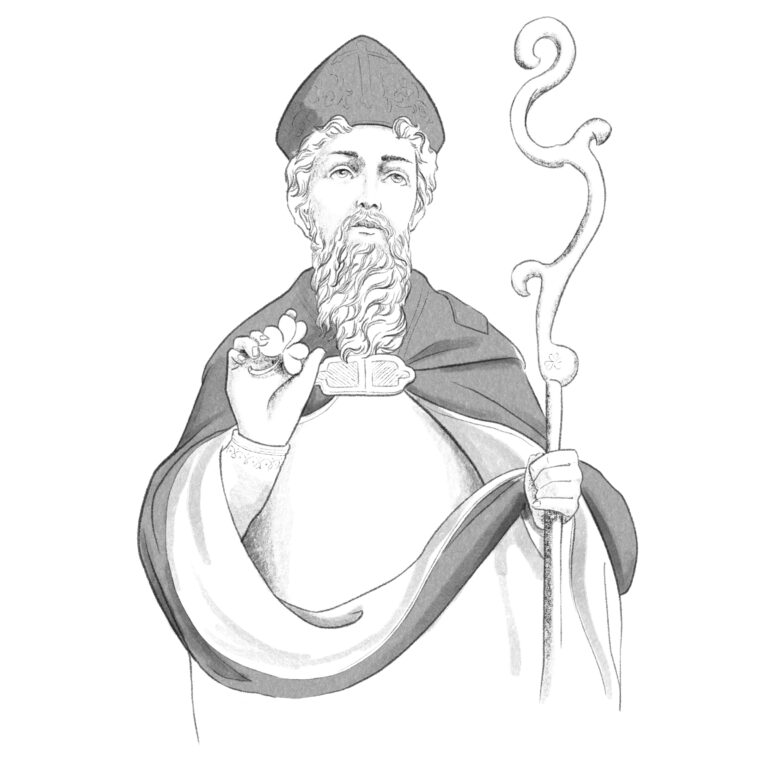



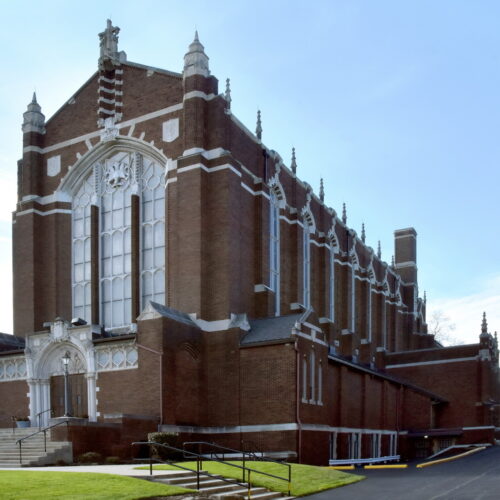
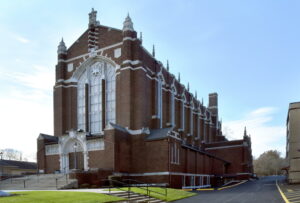
St. Patrick Parish in Youngstown can trace its beginnings to the booming steel industry in Youngstown in the early 1900s. As St. Columba Parish outgrew its church, Bishop Farrelly of the Diocese of Cleveland asked Father Edward Mooney— who grew up in St. Columba and was teaching at the seminary—to select a new site for a parish in the south side of Youngstown. Father Mooney would go on to become Cardinal Mooney. Bishop Ferrelly chose the patronage of Saint Patrick for this new parish and appointed a resident pastor in 1911. The parish purchased the property, which included a six-room frame house that became the temporary rectory and chapel for daily Mass. Sunday Masses were offered in the basement of St. Columba Church, until November 12, 1911, when a Spanish Mission- style church was dedicated for the parish. Next, the parish turned its attention toward a rectory and a school, which would open in 1914, staffed by the Sisters of St. Joseph of Cleveland and three lay teachers. The parish also had a pre-National Football League professional football team, the Patricians, which posted an undefeated season in 1915 and claimed the national championship.
As the parish continued to grow, it underwent several expansions over the years— the cornerstone for a new church building was laid in 1924 with a crowd of more than 2,500 in attendance and a second school building was added in 1953. In 1944, the Sisters of St. Joseph of Cleveland left the school, and the Ursuline Sisters of Youngstown took over as teachers. St. Patrick Parish also hosted the cathedral parish and all diocesan Masses when the cathedral burned down in 1954. Though many parish programs expanded, school enrollment declined, forcing the closure of the school in 1996.
Since then, the Gothic- style church has undergone several renovations and the parish has become deeply committed to service ministries, including Habitat for Humanity as well as 4-H, as the community has created a large urban garden on the property. While many of the original parishioners of the parish were Irish, the parish’s dedication to Saint Patrick is more of a reflection of their commitment to the mission of the Church and their enduring faith.
Description from The March of the Eucharist, 2nd edition (2025) published by The Catholic Echo