October 28, 2025
To the Clergy, Religious, and Faithful of the Diocese of Youngstown,
Traditionally, in the month of November it is our custom as Catholics to pray for and remember our beloved dead. These prayerful remembrances typically involve such things as Holy Mass, the veneration of relics, Books of Remembrance and visits to the cemetery.
As we remember our beloved dead, we also become mindful of our own mortality and the need to prepare accordingly. To that end, it is important that we embrace this November time to prepare a Last Will and Testament, along with Advanced Medical Directives with the establishment of a Durable Power of Attorney and ensuring that we have in place arrangements for a proper funeral and burial. Some people even are intentional about selecting the readings and music for their funeral liturgy. Some make it known as to whether they prefer direct internment or cremation. At the time of our death, our loved ones can find solace from their grief in knowing that everything is in order and few if any decisions need to be made on their part.
At a time in which words are hard to come by, the Church has in place an Order of Christian Funerals that offers words and a direction forward in commemorating the death of a loved one while, at the same time, celebrating their life with reverence and solemnity. The Church is always available and willing to accompany those who are grieving the loss of a loved one. The clergy and staff of our parishes stand ready to be of support to you when your loved one dies along with our local funeral directors. Our diocese is blessed to collaborate with these professionals at what is unquestionably a difficult time.
In recent years throughout our diocese those involved in parish life and pastoral care to the grief stricken who have lost a loved one have been experiencing a definite and growing trend. The trend concerns the locations of wakes or visitations in the parish church. It should be noted that this trend does not happen in some of our churches given the fact that the church building is unsuitable for such an arrangement. Another reason why it may not happen is that the pastor, out of respect for the sacredness of the church, has not permitted it to happen. Some of these permissions depend solely on the pastor and when a new pastor changes direction it can become personal and problematic. Despite the growing trend, there is no consistency in practice in our diocese making the protocols uneven and disjointed. As a result, for the past year, we have been with the help of our funeral directors, presbyteral council, and deans examining this situation in the hopes of establishing a uniform policy for the diocese that would best reflect Church teaching and give both due respect to our church buildings and the deceased as well.
In reviewing this matter, it was discovered that many years ago when a member of the Catholic faithful died, the wake or visitation would often take place in the family home. The purpose of this event was to gather as a family to mourn, tell stories and to pray together. Eventually, the age of funeral homes arose, and funeral home became the place for visitations.
Today more families are requesting to hold the visitation for a loved one in church. This increasing trend to hold visitation in church can be attributed to several factors including, a matter of convenience, and cutting costs.
One of the concerns about having visitation in church is that the sacred space is compromised by noise and activity unbecoming of the reverence due to the Blessed Sacrament. The recent National Eucharistic Revival called a greater attention to the Holy Eucharist and the need to practice and maintain proper respect and reverence. While we pray for the dead in our churches, they are not meant to be a funeral home.
The church building is where the community gathers to hear the Word of God, to pray together, receive the sacraments and to celebrate Holy Eucharist. The church building is both the house of God on earth and a house fit for prayer. Churches are sacred buildings intended for divine worship and prayer.
The structure of the Order of Christian Funerals serves as a guide in the discernment of this matter. The funeral liturgy is comprised of specific stations. The first part of the funeral liturgy is the Vigil which involves the prayers to be prayed during the visitation in the funeral home. The second part of the liturgy is the Transfer of the Body to the Church. The fact that there is a transfer to the church clearly indicates that the ritual does not envision a viewing in the church building.
Article 1686 of the Catechism of the Catholic Church references the Order of Christian Funerals and identifies three places in which the rites are conducted, namely, “the home, the church, and the cemetery.”
The only exception to this practice is when a priest or religious dies. The priest or religious is customarily placed in the church/chapel for public visitation. This is a tradition of the Church that will continue to be practiced in the Diocese of Youngstown.
According to the Order of Christian Funerals, we celebrate the funeral rites to offer worship, praise and thanksgiving to God for the gift of a life which has now been returned to God, the author of life and the hope of the just. (Order of Christian Funerals #5)
Having funeral visitation in one of our churches is not in keeping with the spirit of the Order of Christian Funerals. Moreover, our study of this matter found that it is not practically possible in many of parishes for various reasons, therein, exposing a glaring inconsistency in practice.
Therefore, a after year-long study with the unanimous support of the Presbyteral Council, the Deans, the Pastoral Council, members of the clergy, and some of our area funeral directors, I hereby decree that funeral visitation will no longer be permitted in church buildings or facilities owned and operated by the Diocese of Youngstown effective December l, 2025. The only exception to this practice will be when a priest or religious dies. The priest or religious is customarily placed in the church/chapel for public visitation. This is a tradition of the Church that will continue to be a practice in the Diocese of Youngstown.
Please know that as bishop I have a responsibility to ensure the sacredness of our church buildings with proper reverence for the Holy Eucharist. Moreover, I cannot allow a trend to compromise the spirit of the Order of Christian Funerals.
As we continue our earthly journey as pilgrims on the way, let us continue to prayerfully remember our beloved dead. “Eternal rest, grant unto them, 0 Lord, and let the perpetual light shine upon them. May their soul and all the souls of the faithful departed through the mercy of God rest in peace. Amen.” And together, let us pray, “That all may be one.”
Sincerely in Christ,
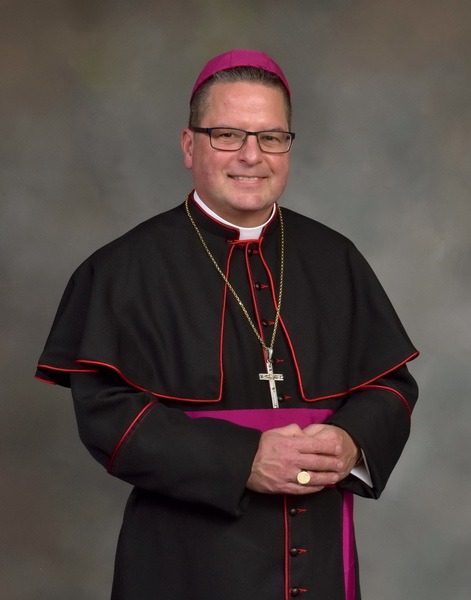
Most Reverend David J. Bonnar, Bishop of Youngstown